Review: Accountant 20 Oz Skinny Tumbler Wrap Design
As a designer who spends more time staring at stitch maps than most people care to admit, I approach every new digital embroidery file with a healthy dose of skepticism. We have all been there: you buy a design based on a glossy thumbnail, only to find out the stitch density is a nightmare or the scaling is impossible for standard hoops. Today, I am breaking down the Accountant 20 Oz Skinny Tumbler Wrap. While the product listing categorizes this under Tumbler Wraps and Graphics, my job is to look past the sublimation potential and evaluate its viability for actual needle-and-thread work. Can this specific layout translate into a high-quality embroidery project for a craft business? Let's dig in.
First Impressions and Visual Personality
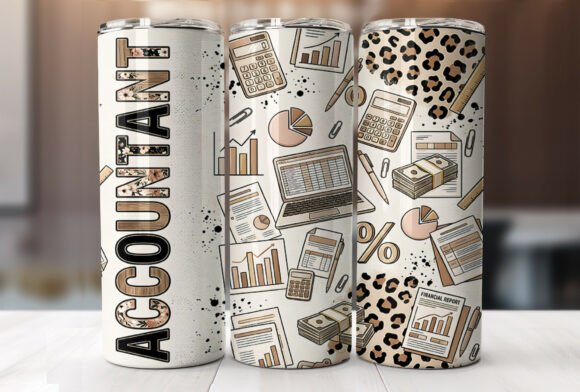
The first thing that strikes me about the Accountant 20 Oz Skinny Tumbler Wrap is its dimensional specificity. The file dimensions are listed at 9.3×8.2 inches with a resolution of 300 DPI. For a sublimation printer, this is gold. For an embroiderer, however, these numbers trigger immediate logistical questions. The "skinny" aspect suggests a tall, narrow composition, which is fantastic for vertical real estate on items like aprons or the side of a tote bag. The theme is inherently professional yet playful, targeting a niche that often gets overlooked in favor of generic "boss lady" scripts. This design feels tailored for someone who takes pride in their number-crunching skills but wants a touch of personality. It creates a mood of organized chaos turned into art, which is perfect for a personalized gift during tax season or as a boutique item for an accounting firm's office party.
Translating Graphics to Stitch
Here is where we need to be realistic. The product description explicitly states this is a PNG file intended for printing. It does not list formats like PES, DST, or XXX, nor does it provide a stitch count. If you are planning to load this directly into your machine as a machine embroidery design, you cannot do so without digitizing it first. This is a crucial distinction for any Etsy seller or small shop product creator. You are buying a graphic asset, not a ready-to-stitch embroidery file.
However, if you have access to digitizing software or a trusted digitizer, the layout of the Accountant 20 Oz Skinny Tumbler Wrap offers excellent potential. The straight and tapered variations mentioned in the specs give you flexibility. The straight version would work beautifully as a sweatshirt embroidery piece down the sleeve or across the chest. The tapered option mimics the curve of a cup but could easily be adapted for an embroidered patch shape. When converting this graphic, I would recommend focusing on clean fill stitch areas for the background elements and crisp satin stitch for any text or borders to ensure readability. Avoid overly complex applique design techniques unless you simplify the graphic first, as the original detail level might get lost in fabric layers.
Real-World Application Scenarios
Let's imagine a real-life scenario. You run a small home-based business specializing in gifts for professionals. Tax season is approaching, and you want to create a line of custom apparel for local accountants. Using the visual data from the Accountant 20 Oz Skinny Tumbler Wrap, you could digitize a simplified version for a high-quality canvas tote bag design. Imagine a sturdy navy tote with this design stitched in gold and white thread. It screams professionalism.
Alternatively, consider baby embroidery. While the theme is corporate, the aesthetic could be softened for a "future accountant" onesie or a nursery pillow cover. The key here is scaling. Since the original graphic is nearly 9 inches tall, you would need to scale it down significantly for infant wear. This is where checking the hoop size becomes critical. Most home machines max out at a 5x7 or 6x10 hoop. You must ensure that when you shrink the design, the thread colors remain distinct and the details don't merge into a muddy blob.
For holiday embroidery or teacher gifts, this design could be adapted onto a kitchen towel or a tea towel. Linen provides a great fabric texture that contrasts well with shiny rayon threads. Just remember that towels require a cut-away stabilizer to prevent the stitching from puckering after multiple washes. If you are aiming for commercial embroidery quality, consistency is key. You wouldn't want the design looking distorted on one cap and perfect on another.
Technical Challenges and Fabric Considerations
Working with a design derived from a large graphic like the Accountant 20 Oz Skinny Tumbler Wrap comes with pitfalls. First, stitch density. If you blindly auto-digitize a 300 DPI PNG, your machine might try to stitch every pixel, resulting in a cardboard-like stiffness that no customer wants. You must manually reduce density, especially if using this on stretchy fabrics like t-shirts or thin materials like baby clothes. On dark fabrics, you will need to plan for an underlay or perhaps a white backing fabric if you decide to go the applique route, ensuring the colors pop without requiring ten layers of thread.
Curved surfaces present another hurdle. While the original intent is a skinny tumbler, applying this to a curved surface like a baseball cap requires careful manipulation of the design matrix. The taper mentioned in the file specs helps, but you still need to account for the curvature of the cap's front panel. Tiny lettering is another risk area. If the graphic includes fine print typical of accounting disclaimers or jokes, those elements will likely vanish when stitched. I strongly advise removing micro-details before sending the file to the machine.
Maximizing Value and Professionalism
The ultimate goal of using assets like the Accountant 20 Oz Skinny Tumbler Wrap is to elevate your handmade product above the sea of mass-produced junk. When executed correctly, a well-digitized version of this design adds perceived value. It shows attention to detail and niche targeting. For creative entrepreneurs, this means higher price points and better customer trust. A client seeing a cleanly stitched logo or theme on a high-quality garment knows they are buying a finished product made with care, not a cheap transfer that will peel off in the wash.
Furthermore, using this graphic for printable mockup creation before you even stitch a single thread is a smart business move. You can show clients digital previews of how the design would look on various design assets like hoodies, patches, or bags. This saves time and materials, allowing you to secure orders before committing to production. It bridges the gap between digital sales and physical goods, making it a versatile tool for both digital product sellers and physical crafters.
Final Designer Notes and Best Practices
Before you commit to a full production run, here is my practical advice. Always test the design on scrap fabric first. Do not skip this step. Check how the thread color contrast looks under different lighting conditions. Review the stitch direction; does it follow the natural drape of the fabric? Confirm your hoop size limitations early so you aren't halfway through a project realizing you need to re-hoop. Inspect small details closely; what looks sharp on a screen might be a bird's nest of thread on fabric.
Test your digitized version in black and white mockups to ensure the value structure holds up without relying on color. Compare how it sits on light versus dark fabric texture backgrounds. Use the proper stabilizer for the specific garment; water-soluble for towels, cut-away for knits. Finally, and most importantly, check the licensing terms. The product description notes this is a digital file for printing. Ensure you have the rights to modify, digitize, and sell the resulting embroidered items. Some graphic licenses prohibit derivative works like embroidery. Clarify this with the seller to protect your craft business.
In conclusion, the Accountant 20 Oz Skinny Tumbler Wrap is a solid starting point for a niche embroidery project, provided you treat it as a graphic source rather than a ready-made stitch file. With thoughtful digitizing and careful material selection, it can become a standout piece in your portfolio, delighting clients who appreciate both humor and craftsmanship.